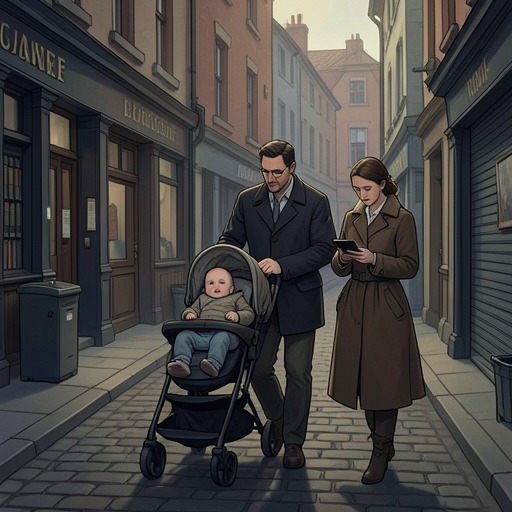
Hacine–Océane father-daughter relationship
And Their Children After ThemHacine’s bond with his daughter Océane is defined by a painful contradiction: he loves her intensely and fears for her safety, yet fatherhood does not relieve his dissatisfaction or make him feel at home in his own life. As the demands of caring for a baby sharpen the distance between Hacine and Coralie, his relationship with Océane becomes both a source of profound attachment and a measure of how little he knows how to change.
The arrival of Océane
After Hacine and Coralie bring their daughter home from the maternity ward, their days settle into an exhausting cycle of night wakings, bottle preparation, diaper changes, walks, and work. The routine leaves little room for rest or conversation. Hacine and Coralie struggle to talk without arguing, and often pass one another like zombies, joined less by intimacy than by the practical work of keeping their fragile household going. Océane is six months old in early August, and her needs reorganize nearly every part of their daily life.
The strain reaches beyond the couple. Coralie’s parents visit without warning to see the baby and help, bringing soup and taking over domestic tasks. Coralie’s mother leaves an apron and cleaning products, reorganizes the kitchen drawers, and treats the couple’s home as a place where she can intervene. Hacine recognizes that these relatives have adopted him, and he is grateful for their support, but their habits and fixed routines also make him feel out of place. Their assistance helps sustain the household while making his sense of displacement more acute.
A family life that feels borrowed
Hacine describes himself as a stowaway in his own life. Sitting with his father-in-law to watch the news, he feels that nothing around him appeals to him or resembles him; he behaves and waits. The in-laws’ measured meals, thrift, conventional beliefs, and steady faith in familiar institutions deepen his alienation. His resentment is directed at the whole environment in which new fatherhood is unfolding, not at Océane alone. The home provides shelter and practical help, but he experiences it as a life arranged by other people’s rules.
His relationship with Coralie also changes after the birth. She is depressed about the twenty-five pounds she has not lost since pregnancy and cries readily; when Hacine tries to put things in perspective, his reassurance makes matters worse. Their arguments and exhaustion crowd out their sexual relationship, which stops. Coralie naps repeatedly, while Hacine sleeps on the sofa at a later point, behaving, in his own understanding, like a deserter from the family he is still living in. Océane’s arrival has not created this distance so much as intensified the conditions in which it becomes impossible to ignore.
Hacine distinguishes his response to his daughter from Coralie’s. He does not resent Océane, feel jealous of the attention she receives, or tell himself that he has better things to do than care for a baby. Coralie, he thinks, had always carried an inner emptiness, and Océane fills it completely: the baby becomes the measure by which everything else is judged. Hacine says that he has never felt that same vacant space. Océane comes into a life already crowded with neuroses, unhappiness, and persistent rage, and so her arrival does not make life feel sufficient. His affection is real, but it cannot by itself settle the distress that precedes it.
Care, escape, and fear
The purchase of a Suzuki DR makes the household’s conflict over responsibility concrete. When a salesman at Hacine’s store advertises the motorcycle, Hacine goes to see it and writes a check without thinking. Coralie yells at him: they are already in serious financial trouble, will not take a vacation that year, and have no garage in which to keep it. She also warns him that motorcycles kill their riders. Her question about when he will grow up turns the purchase into a judgment about his capacity to act as a partner and father. The evidence does not suggest that buying the motorcycle is a rejection of Océane, but it shows Hacine making an impulsive decision while family obligations and money are pressing on them.
During the 1998 FIFA World Cup, Hacine increasingly uses football as a way to withdraw from the household. He goes to a bistro with coworkers rather than coming straight home, wanting to watch France play Denmark and avoid the apartment, his in-laws, and the crying. He is too preoccupied with the scene awaiting him to notice the first goal, and leaves at halftime with guilt and frustration. When he returns, Coralie and Océane are gone to Coralie’s parents’ home. Hacine admits to himself that he feels relieved. Alone, he eats noodles, watches the rest of the match, and goes to bed after taking Temesta. In the shower he wonders what to do with his life: he loves Océane, who demands nothing of him, but feels trapped and believes he cannot stay as things are.
Coralie returns the next morning, but the couple barely speaks over the following week. As France advances through the tournament, Hacine immerses himself in matches, news, commentary, and newspapers. The national excitement gives him somewhere else to place his attention while the silence at home continues. He meets only the bare minimum of childcare: changing every other diaper, giving a bottle now and then, and putting Océane to bed, perhaps singing briefly. He sleeps on the sofa. His withdrawal is not presented as indifference to his daughter; rather, his love and his evasion coexist, leaving Coralie to carry much of the daily burden.
Attachment under pressure
Coralie eventually tells Hacine that unless he changes, she will leave with Océane and he will never see them again. After she goes out, Hacine is left with the baby when he has to be at work within the hour. His mother-in-law arrives and takes Océane without making a fuss. The ordinary practicality of this intervention is important: an adult steps in to care for the child, but Hacine must still hurry away to work, with the threat of separation hanging over the family.
As he prepares to leave, he hears his mother-in-law making playful sounds until Océane bursts into laughter. The baby’s happiness seems astonishing to him in its simplicity: so little is needed to sustain this tiny life, and so little could end it. His thoughts turn to accidental dangers, including a fall, a passing car, or drowning in a bathtub. This fear does not cancel his earlier avoidance; it reveals the vulnerability underneath it. Before climbing onto his motorcycle, he kisses Océane on the head and on her fist. Coralie has taken the car, so the small farewell is also the last image of their immediate separation in these passages.
Hacine’s fatherhood therefore remains unresolved rather than transformed into a simple story of either rejection or redemption. He explicitly loves Océane, recognizes that she is not responsible for his discontent, and responds to her fragility with intense fear and tenderness. At the same time, he retreats into football, resists the pressures of domestic life, and fulfills only a limited share of the daily care described. The bond matters precisely because these feelings do not cancel one another: Océane is deeply loved, but that love alone does not make Hacine feel less trapped or repair the strained partnership on which her care depends.